"Students in Egypt: Between Repression and Violation of Human Dignity"
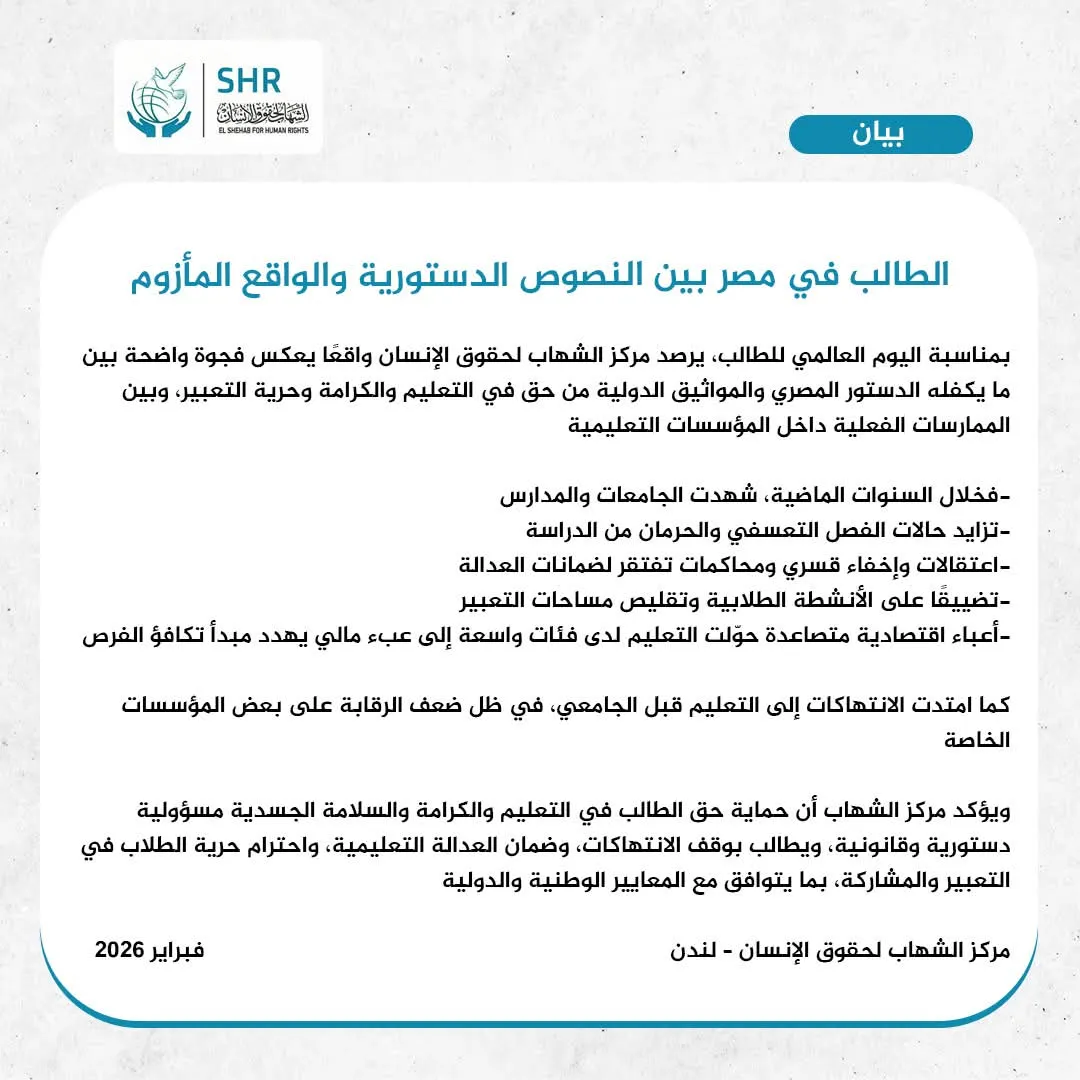
🔴 The Student in Egypt Between Repression and Violation of Human Dignity
- On the occasion of the International Students' Day in Egypt, which falls on November 21 each year, the Al-Shehab Human Rights Center monitors and documents the violations faced by students within educational institutions. It highlights the need for the central issue to remain focused on the role of the student in society and their right to learn and participate. Considering Egypt's commitments to international treaties and United Nations statements, it is evident that students are active participants in building society and preserving its dignity and rights. These treaties recognize students' rights to education, participation, and dignity in expressing their political and social opinions freely and without repression or discrimination.
The Egyptian constitution stipulates that education is a right for every citizen, and the state is obligated to provide it and ensure its quality and fairness. However, the practical reality from the January 2011 revolution until the end of 2024 reveals a clear gap between constitutional texts and actual practices, especially concerning students' rights within educational institutions, whether at the university level or prior to university education.
This statement aims
to analyze the conditions of students in Egypt by monitoring the economic and political context, the nature of university life, patterns of violations, and the extent to which these practices align with international human rights standards from several perspectives.
First Perspective / The Constitutional and Legal Framework for the Student's Right to Education: The Egyptian constitution guarantees the right to education as an inherent right for every citizen. It obliges the state to oversee public and private educational institutions to ensure their compliance with educational policies and achieve equal opportunities. It also links education to building national character, developing scientific thinking, and instilling the values of citizenship.
However, practical practices, as documented in the report, indicate a clear contradiction between this constitutional framework and the reality of students, where education often transforms from a guaranteed right into a conditional privilege, whether based on financial capability or political positions, which undermines the actual content of legal texts.
Second Perspective / The Economic Context and Its Impact on the Justice Deserved by Students in Educational Institutions: The right to education in Egypt comes amid a pressing economic context, as data indicates that the poverty rate has reached about 32.5% of the population. In this context, the costs of education represent an increasing burden on families that do not align with average incomes, especially with the expansion of private and international education and private universities, in addition to additional fees associated with activities and educational services, leading to class discrimination in access to education, transforming it into a commodity available to limited groups, contrary to the principle of social justice and equal opportunities.
Third Perspective / University Life Between Freedom and Restriction: Since July 2013, Egyptian universities have witnessed a noticeable change in the nature of university life, where student activism has diminished, and political activity within the campus has been criminalized, as well as politically or religiously oriented student groups. Administrative and security restrictions have been imposed on activities, leading to a decline in the university's role as a space for dialogue and intellectual pluralism.
Fourth Perspective / Patterns of Direct Violations Against Students: The report documents a wide range of violations faced by students during the years 2013–2024, the most prominent of which is arbitrary dismissal, where:
1,064 students were subjected to arbitrary dismissal.
1,286 cases of temporary and permanent dismissal were recorded within a short period.
Approximately 900 students were dismissed from Al-Azhar University in one academic year.
94 cases of final dismissal were recorded at Cairo University.
Female students comprised the majority of those dismissed, with 176 out of 283 cases.
Violations also included deprivation from exams and continuation of studies, especially for detained students, due to the obstinacy of university administrations or refusal to transfer them from detention places, in clear violation of the legally guaranteed educational rights.
Fifth Perspective / Arbitrary Arrest and Enforced Disappearance: The statement documents a sharp increase in cases of arbitrary arrest of students, with 1,010 cases recorded during 2015 and continuing to rise. About 39.6% of these students experienced enforced disappearance for varying periods.
Additionally, 486 cases of enforced disappearance were documented during the years 2013–2015, a phenomenon often associated with the risks of torture and forced confessions, directly affecting the right to education and the physical and psychological safety of students.
Sixth Perspective / Unfair Trials and Harsh Sentences: 160 students were referred to military courts between 2013 and 2015, receiving a total of 743 years in prison sentences, in addition to financial fines exceeding 1,229,000 Egyptian pounds.
Some cases included death sentences in trials described as lacking the basic guarantees of a fair trial, especially amid allegations of torture and coercion to obtain confessions.
Seventh Perspective / Extrajudicial Killings: In 2015, 24 cases of extrajudicial killings of university and institute students were recorded, and several students lost their lives during the dispersal of protests or inside detention places, in contexts where excessive force was used, without effective accountability or independent investigations. Many detained students continue to face persecution and serious violations inside prisons, including deprivation of basic healthcare, exposure to violence, and deaths resulting from medical negligence, which constitutes a clear violation of human rights and international treaties that guarantee the protection of every student's life and dignity.
Eighth Perspective / Recent Violations Against Students in Pre-University Education: Violations have extended to pre-university education, where serious incidents have occurred in some private and international schools, including physical and sexual assaults against children, along with cases of administrative cover-up and weak oversight and accountability mechanisms.
Ninth Perspective / International Standards for Students' Rights and Their Conflict with Reality: These practices contradict international human rights standards, which guarantee the right to education, non-discrimination, academic freedom, and protection from arbitrary arrest and violence. This contradiction reflects a breach of the state's international obligations and places the conditions of students in Egypt under continuous human rights scrutiny.
Recommendations of Al-Shehab Center
First: Full commitment to the Egyptian constitution and ensuring the right to education for all, without discrimination or financial or political restrictions.
Second: Developing oversight and supervision mechanisms for public and private educational institutions to ensure equal opportunities and quality education.
Third: Protecting students from political violations and stopping arbitrary arrests and enforced disappearances of students, ensuring fair and transparent trials according to international standards, as well as ensuring safety inside prisons and detention places, providing basic healthcare for all detained students, and preventing medical negligence that could lead to death, and establishing independent mechanisms to investigate any death or violation occurring inside prisons and holding accountable those responsible.
Fourth: Empowering students with freedom of expression and political and social participation within universities and schools, while respecting intellectual pluralism.
Fifth: Enhancing oversight of private and international schools to ensure a safe educational environment free from physical or sexual assaults.
Sixth: Preventing the continuation of a student in school from being linked to financial capability, to ensure the right to education for all.
Seventh: Complying with international standards and norms for students' rights, integrating human rights principles into educational curricula and university and school policies, which enhances awareness of students' rights and duties, and cooperating with international human rights organizations to ensure effective monitoring and addressing of violations.
Conclusion
This statement illustrates the reality of students in Egypt despite constitutional texts and international commitments, as a clear gap remains between the rights guaranteed for students and actual practices, whether at the pre-university education level or universities, or in the context of arbitrary arrests, unfair trials, and extrajudicial killings, along with accompanying violations in detention places. Addressing these gaps requires comprehensive and continuous efforts to ensure a safe and just educational environment, protecting students from any form of political or social persecution.
Al-Shehab Human Rights Center London - February 2026